
- News
- City News
- delhi News
- A lakh e-rickshaws on road, just 4.5k legal
Trending
This story is from August 28, 2016
A lakh e-rickshaws on road, just 4.5k legal
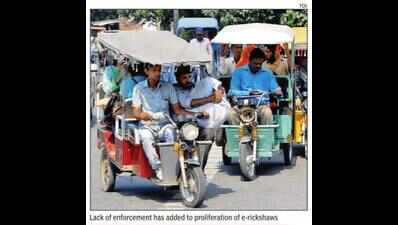
E-rickshaws were introduced in the city to provide lastmile connectivity from bus and Metro stations. However, most of them are not registered with the transport authority . Also, in most cases, they are driven rashly -and by young men without licence.

One such driver, Ranjeet Kumar (27), continues to ply an unregistered vehicle despite having been caught once and asked to shell out a Rs 600-fine.He says, “I applied for a licence two months ago, but there's been no movement on my application. I've to pay off the loan on my vehicle. So, I've no other option but to ply illegally.“
Another driver, Rumesh Kumar (25), who operates from Kailash Colony Metro station, agrees: “The rickshaw cost Rs 1 lakh and I need to spend another Rs 50,000 to get a fitness certificate. I can't afford it.“
Unregistered vehicles, however, are the least of the city's problems. Most e-rickshaws are run with little regard for traffic rules: drivers can ferry only four passengers at a time.Adherence to this norm on Delhi roads remains a pipedream.
While commuters complain of rashly driven e-rickshaws, they prefer it over other modes because of economy . Says Anchal Sharma (34), a resident of Sant Nagar: “Earlier, I had to walk a kilometre to reach the Metro station, but now it hardly takes 5 minutes in an e-rickshaw.“
The regular autowallahs are, of course, miffed. “These drivers have no licence or batch number. They drive rashly and the police let them ply freely ,“ says Gurdeep Singh, who drives an auto in south Delhi. Traffic police, on the other hand, claim to have restricted the movement of e-rickshaws on main roads to avoid congestion.
End of Article
FOLLOW US ON SOCIAL MEDIA






Photostories

Hot Picks
TOP TRENDING
Popular Categories
Hot on the Web
Top Trends
Hurricane Milton LiveRBI MPC Meet LiveWorld First Top 10 TrillionairesVinesh Phogat Election ResultTravis KelceElection Results 2024Haryana Election ResultJason KelceJammu Kashmir Election Result 2024Israel Hezbollah WarHardik SinghAakash ChopraJammu Kashmir Election Winners ListGurgaon Election ResultHaryana Election Winners ListFaridabad Election ResultLive Cricket Score
Trending Topics
Tulsi KumarBigg Boss Tamil 8 Contestants ListAjay DevgnNavratri Colours 2024Sanjay Leela BhansaliDurga Puja 2024Bigg Boss 18 House PhotoDevara CollectionBigg Boss 18Deepika PadukoneShailesh LodhaDevaraGovinda NewsNational Film Awards 2024Swatantrya Veer SavarkarColdplay India tour 2025Watch NFL Live StreamDress To ImpressCall Of Duty Black Ops 6Wordle Answer
Living and entertainment
Latest News
After crackdown, Hyderabad’s infamous ‘bride bazaar’ moves onlineMozambique votes in tense election likely to see ruling party winAdnaan Shaikh's father Abdul Mabood Shaikh makes a shocking revelation amid the ongoing feud with his sister Iffat; says 'My daughter's in-laws are forcing her to do this'Libra, Daily Horoscope Today, October 09, 2024: Today is a test of your resilienceWrestler-turned-politician Vinesh Phogat's educational qualifications and net worthMan declares income of Rs 9.6k, pays tax on Rs 43.5L after US earnings addedHarmanpreet Kaur fit for Sri Lanka match, conditions have been different from expectations: MandhanaPatanjali Foods gets CCI nod for Rs 1,100-crore buyout of parent's home & personal care businessDocumentary suggests Bitcoin creator Satoshi Nakamoto is developer Peter Todd2024 Haryana assembly election result: 5 reasons why BJP's victory is significantKathua (SC) Assembly Election Result 2024: BJP's Dr Bharat Bhushan wins by 12,177 votesHappy Durga Puja 2024: Best Messages, Quotes, Wishes, and Images to Share on Durga PujaShweta Bachchan Nanda reveals Amitabh Bachchan and Jaya Bachchan's great skin is due to mustard oil: 'They never had cosmetic treatments or procedures done'Alexander Zverev scrapes through, set to face David Goffin at Shanghai Masters pre-quartersRoh Yoon Seo shines as a supportive sister in 'Hear Me: Our Summer'Best TVs Of 2024 In India: Top Picks For Every BudgetSuhana Khan pens a fun caption directed to Shah Rukh Khan and Karan Johar along with picture of ‘birthday girl’ Gauri KhanKarcher launches autonomous cleaning devices, robotic vacuum cleaners; aims to expand India operations
Copyright © 2024 Bennett, Coleman & Co. Ltd. All rights reserved. For reprint rights: Times Syndication Service